The Camino de Santiago is an unforgettable experience that culminates in Santiago de Compostela. However, the accumulation of miles, and the physical effort daily imply a requirement that is significant to the body. For many pilgrims, the pain and discomfort, muscle or joint become companions along the way.
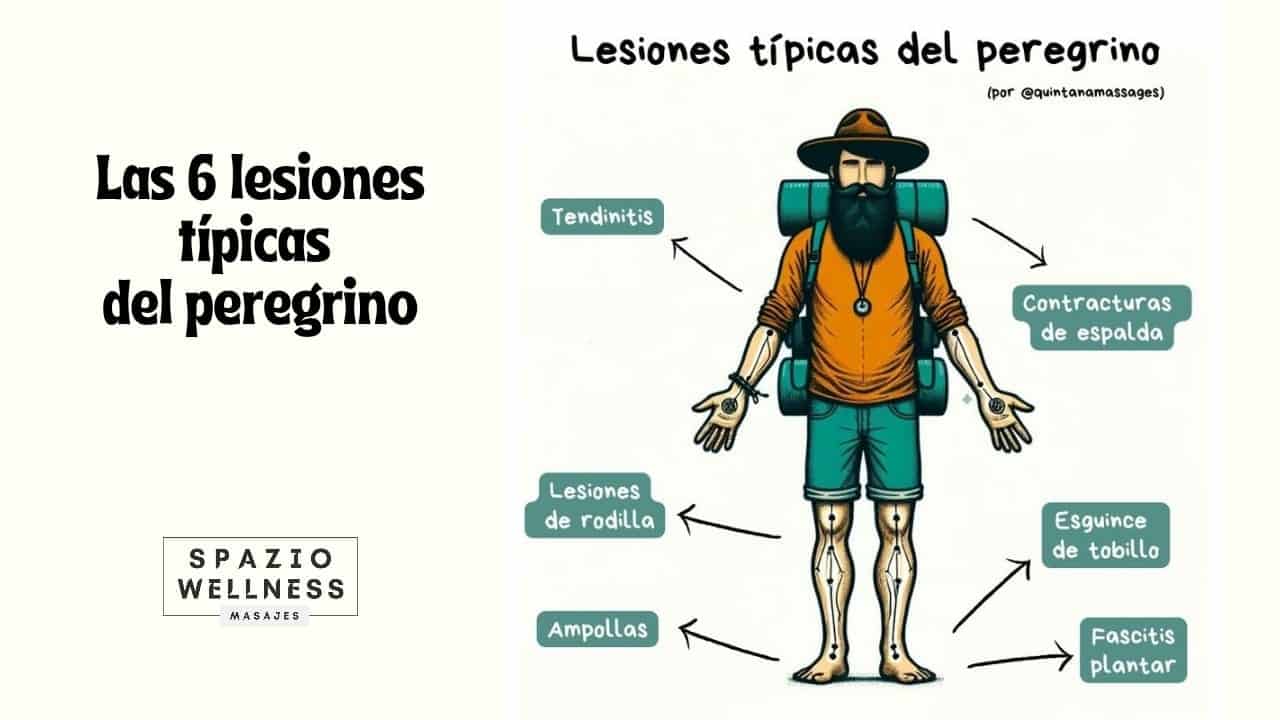
Know the ailments most common and know how to prevent it is crucial to ensure that the arrival to the Plaza del Obradoiro be a celebration, not a relief force. Below, we break down the 6 most common injuries of the Camino de Santiago and we offer effective strategies to avoid them.
The 6 most common injuries of the Camino de Santiago and how to avoid them
Prevention, and management of blisters: the most frequent lesion in your Way
1. Blisters of the pilgrim
The blisters are, without a doubt, the discomfort is more common and the main cause of interruption of your gear. They are a response of your skin to excessive friction and humidity constant.
- What are they really? A buildup of fluid under the superficial layer of the skin, a protective bubble that is formed by the constant pressure of your foot in the shoe.
- The source of the problem: The use of new shoes or inappropriate, cotton socks (to retain moisture) and the friction repetitive at points of support, key, especially during the first days or on rainy days.
✅ Prevention strategy: take care of your feet and choose either the computer,
The prevention is the only treatment really effective for blisters.
- “Taming” your shoes: you’ll Never have shoes on the Way! Your boots or shoes must be tested and shaped to your foot. Bake made for months in your previous workouts.
- Socks technicians: Invest in socks without seams, made of synthetic fibers or wool, merino, the removal of the moisture. Change your socks at least once a day, or if you notice the foot wet.
- Hygiene and protection – Before-the-fly, apply petroleum jelly or creams-specific friction in the areas most prone (heel, floor, fingers). At night, thoroughly wash and dry your feet and rest them on the air.
- Immediate attention: If you notice a hot spot, stop and put a protection (dressing, hydrocolloid, or taping) before forming the blister.
🦵 Tendinopathies and fasciitis: the challenge of injuries to muscle overload
Overuse injuries are those that arise from the accumulated fatigue, when the soft tissue begins to swell by the constant repetition of the gesture of walking. Among them, tendinitis and plantar fasciitis are those that can become disabling.
2. Tendinitis of the Achilles tendon and patella
The tendinitis Aquilea or the patella (pain in the front of the knee) is manifest as a throbbing pain that is worse with movement. Usually appear at the start of the stages and at the end.
- Primary cause: Abrupt increase in the intensity and the distance (lack of previous training), land with much slope (climbs and long descents) and a shortening of muscles (gastrocnemius and quadriceps).
3. Plantar fasciitis pilgrims
The pain is localized in the heel or the sole of the foot and is especially intense when you get up in the morning or after periods of rest. It is the inflammation of the plantar fascia, the tissue that runs from the heel to the toes.
- Main cause: Shoes with little cushioning, excess weight in the backpack, and a footer that suffers from an excess of continuing impact.
✅ Prevention strategy: trains, regulates your load and rests
- Planning stages: it Is essential that you increase the distance gradually and listen to your body. Prevents stages excessively long at the beginning.
- Use of trekking poles: The poles trekking are not an accessory; they significantly reduce the load on the knees and ankles (up to 25%), helping to download the tendons and the sole of the foot.
- Stretching constants: Perform gentle stretching of the calves, hamstrings and quadriceps before and after each stage.
- Rest smart: Don’t force if the pain is persistent. A day of rest-time prevents you from having to abandon the route. Once in Santiago, a massage for pilgrims helps to relax and to recover the muscles deep. (Perhaps you may be interested in reading our article on The Benefits of a Massage Post-Road for Muscle Recovery)
Stability and load: sprains, knee pain and low back pain,
The Road runs often on trails irregular, slopes, and areas with stones. Here is where you will put to test your stability and resistance to continued effort.
4. How to prevent ankle sprains in the Way
The ankle spraininjury ligamentous more common, occurs by a support wrong when he stepped on a stone or a drop, especially when fatigue affects your coordination.
- Higher risk: uneven Terrain, and the use of footwear that does not provide enough ankle strap.
5. Patellofemoral pain syndrome (discomfort in the knee)
Is a dull, aching pain around or under the kneecap. Appears by rubbing excessive that occurs with the repetition of the step, something that the long descents and the weight of the backpack to increase exponentially.
- Primary cause: Muscle imbalance and excessive burden on the downs.
6. Back pain and back pain due to backpack
The pain in the lumbar area is a complaint very common, which is directly related to the weight and fit in your backpack.
- Main cause: A backpack too heavy (the weight should not exceed 10% of your body weight) and ill-fitting.
✅ Prevention strategy: optimize your equipment and position
- Adjustment of the backpack: The key is the lumbar belt. The greater part of the weight must fall on the hips, not your shoulders. Adjust the straps so that the backpack is attached to your back.
- Footwear subject: Used shoes that offer good support in the ankle if you are going to walk on terrain that is very technical. The poles, again, will help the overall stability.
- Strengthening prev: Before you begin the Path, it works the strength of your quadriceps, glutes and core (abdominal and low back muscles).
- Pauses active: At stops, moves joint gently, walks a few steps and stretches the back to release the pressure of the backpack. Once in Santiago, a deep tissue massage is ideal for releasing built-up tension in your back and shoulders. (We invite you to view more information about our deep tissue Massage in Santiago)
Recovery and well-being in Santiago de Compostela,
If, in spite of the prevention, your body will take its toll, it is important to act in time. If you experience acute pain, swelling, or limitation on the movement, our advice is to always consult a health professional.
In SPZ WELLNESS Santiago, we specialize in the recovery of muscle strain and joint. Our services are aimed to:
- Massage download for pilgrims: Ideal for work and relieve the muscle tension accumulated in the legs, feet and back, helping to relax the tissues and reduce the pain due to overexertion.
- Foot reflexology: Excellent for revitalizing the feet were sore and treat disturbances such as those caused by tendinopathy, promoting the general relief.
- Derivation professional: Our therapists are in charge of working the muscle discomfort through massage and reflexology. If during the treatment, we detected a major injury (as a sprained important, a persistent pain or a possible hamstring), you we will refer you to a physical therapist or doctor that is appropriate for you to receive the diagnosis and the medical treatment needed.
The Road is a personal goal, not a career. The planning and respect for the limits of your body are the best tools to fully enjoy the experience. If you have the fortune of getting to Santiago de Compostela, don’t hesitate to give your body the reward and the rest that it deserves.